
01 / OUR FLAGSHIP MACHINE
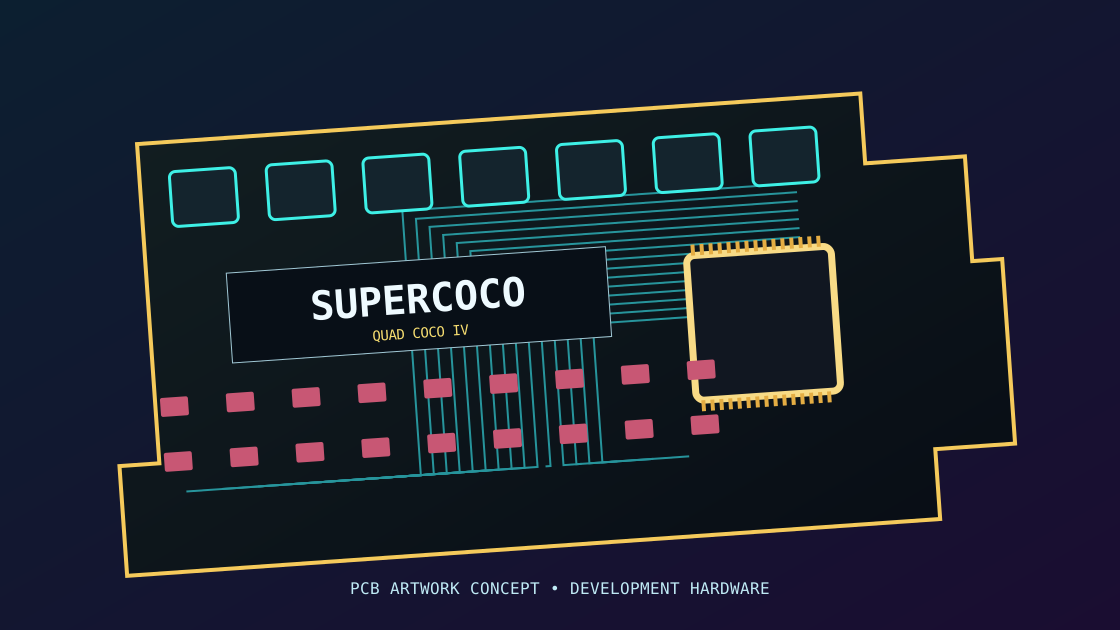
SUPERCOCO
The Color Computer future we imagined — a new machine built in FPGA logic, rooted in the CoCo's spirit and designed to give its software new places to go.
Development status: RTL and PCB-boundary verification are underway. This is not finished or available for purchase.
02 / INSIDE THE MACHINE
A familiar heart. A larger horizon.
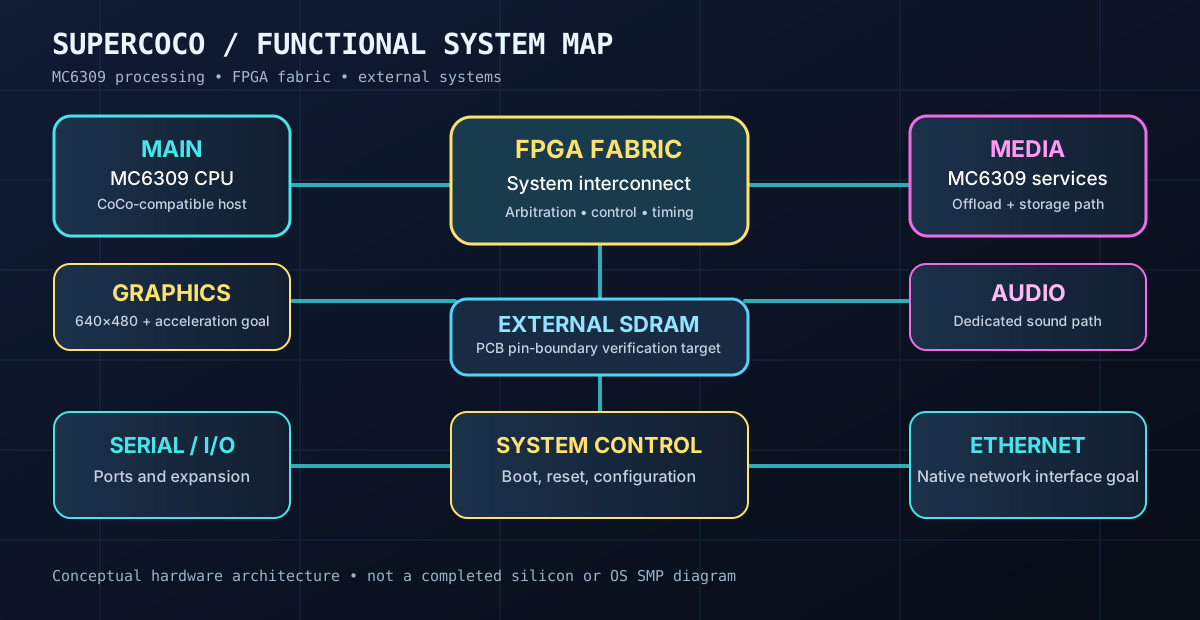
SuperCoCo's AUAD-oriented architecture brings processing, media, graphics, sound and modern I/O into one integrated FPGA system. Our current hardware closure goal is a verified top-level design at the intended PCB boundary, including CPU boot and external SDRAM read/write. The diagram below is a functional map, not a claim of independently verified processor count.
MAIN and MEDIA
MC6309-based processing work for the main machine and media services, integrated through FPGA system logic.
Video and sound
640×480 output and graphics acceleration are targets, supported by a dedicated audio-processing path.
Memory and connectivity
External SDRAM, serial interfaces, Ethernet and expansion are part of the PCB-boundary design work.
Hardware options
Two proposed form factors: a CoCo 3 case-replacement board and a Mini-ITX-style motherboard.
Emulator
A companion emulator is in development for software exploration, compatibility work and future public release.
Development discipline
We verify RTL and physical pin behavior before promising finished hardware, production dates or exact performance.
03 / BEYOND HARDWARE
NitrOS-9: a multiprocessor research roadmap.
A faster Color Computer alone is not the whole vision. We want to explore how NitrOS-9 could use SuperCoCo's multiple processing resources, beginning with cooperating processors and offloaded services. True shared-memory SMP would be a substantially larger operating-system project — not something we're claiming exists today.
Cross-processor services
Explore mailboxes, shared-memory ownership and clear interfaces for media and I/O work outside the MAIN CPU.
OS and driver support
Develop testable drivers and interrupt/resource coordination for video, audio, storage, serial and networking.
Scheduling research
Investigate task placement, synchronization and, if the architecture supports it, incremental kernel changes toward multiprocessor-aware operation.
Expected contribution, not completed upstream work. NitrOS-9 changes will require implementation, compatibility testing, coordination with maintainers and technical validation. We have not announced accepted upstream SMP patches or a release date.
04 / CONNECT THE ORIGINAL
CoCoWiFi
HARDWARE AND FIRMWARE IN DEVELOPMENT
A cartridge bringing modern networking to classic CoCo 1, 2 and 3 machines — without pretending the computers were designed in the age of the Internet.
Telnet + TCP
Planned Telnet sessions and native TCP operations for modern network applications.
Cartridge design
ESP32-S3 networking and a carefully validated bus-facing register and buffering interface.
Three generations
Targeted compatibility with Color Computer 1, 2 and 3 cartridge slots.
05 / MAKE THE CONNECTION
PeTerm
ACTIVE DEVELOPMENT AND VALIDATION
A capable, colorful terminal program for a genuine Color Computer. Built for real conversations on real BBS systems.
PETSCII / C-G
Commodore-style colors and character graphics, with active CCGMS Future compatibility testing.
Color ANSI
A second display language for a broader range of bulletin boards and hosts.
Transfers + ports
Configurable serial interfaces, XMODEM transfers and an intended NitrOS-9 software path.